
xFusion Launches Scalable AI Solutions at ISC 2026, from Edge to Data Centres

# xFusion Expands Enterprise AI Solutions from Edge Workstations to Liquid-Cooled Data Centres
xFusion unveiled its scalable enterprise AI computing solutions at ISC 2026, showcasing hardware capabilities that transition from edge devices to sophisticated data centres. Attendees at the Hamburg exhibition emphasized the need for practical production frameworks in technology procurement, often failing to consider physical operational limitations. Moreover, reliance on public APIs poses risks to sensitive commercial data.
In response, xFusion engineers introduced a comprehensive four-tier hardware portfolio. This structured deployment allows processing capacity to scale seamlessly across individual workstations, workgroup clusters, corporate office appliances, and facility-level supernodes.
### Personal Edge Processing Devices
Professionals requiring intensive local resources for complex tasks, such as 3D rendering and architectural simulations, benefit significantly from localized processing. Individual users manage large datasets on-site prior to task allocation to centralized computing clusters.
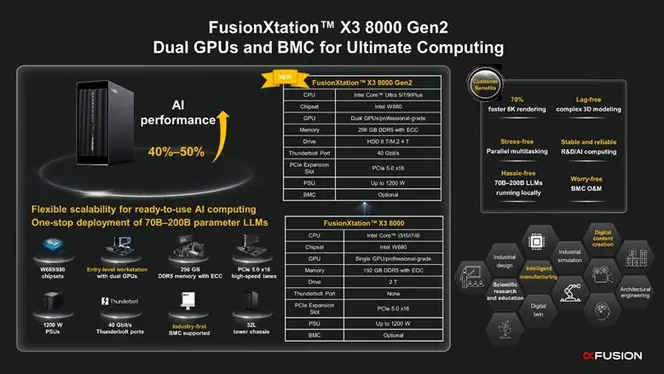
The foundation of xFusion’s offering is the FusionXtation X3 8000 Gen2 edge computing node, designed specifically for roles demanding local execution of extensive models ranging from 70 billion to 200 billion parameters. These workstations integrate Intel Core Ultra processors with dual high-performance graphics processing units. Memory configurations can include up to 256 gigabytes of error-correcting DDR5 RAM alongside internal storage that reaches eight terabytes.
Performance metrics indicate that these setups enhance 8K rendering speeds by 70 percent and elevate general AI processing by up to 50 percent over earlier models. IT administrators can maintain remote access via integrated Baseboard Management Controllers, while four Thunderbolt ports, operating at 40 gigabits per second, facilitate external data transfers.
### Workgroup Data Containment Appliances
Unregulated data movements present significant compliance issues, particularly for organizations in regulated sectors. External application marketplaces may expose corporate networks to cyber threats. Development teams are compelled to create secure, custom software to safeguard intellectual property.
To address compliance, xFusion’s FusionXpark appliance enables engineering units to adhere to regulatory standards throughout the application development process. Teams in fields like medical imaging and financial modeling can securely process sensitive data without interacting with external APIs.
The FusionXpark system allows users to combine two units for the local processing of models containing 405 billion parameters, operating in native CUDA environments. This system initializes directly with NVIDIA DGX OS, providing developers rapid access to essential toolchains while securely routing overflow tasks into DGX Cloud.
### Corporate Token Processing Utilities
Corporate functions demanding high processing power can burden operational budgets due to excessive context transmission. Operations departments require dependable infrastructure for automating customer service routines and handling complex financial approvals.
The TokenBox, created by xFusion, acts as a centralized processing unit for token generation across entire organizations from a single site. Each TokenBox node supports models comprising 1.6 trillion parameters, eliminating the need for costly dedicated server rooms.
These units employ a liquid cooling system that maintains noise levels at just 35 decibels during operations, allowing placement in standard office spaces. Pre-installed software expedites setup times, ensuring quick return on investment.
### Data Centre Computing Engines
The final tier of xFusion’s offerings focuses on liquid-cooled racks and supernodes, essential for expanding computing capabilities within multinational corporate networks. High-density infrastructure packages deliver 240 kilowatts per cabinet, translating electrical input efficiently into floating-point operations per second. Proprietary low-loss core components contribute to a 15 percent reduction in operational costs.
The supernode architecture relies on robust hardware integrated within centralized corporate clusters. The FusionServer G6550 V8 inference server can accommodate up to ten dual-width graphics processing units. The FusionPoD liquid cooling platform effectively manages thermal output, achieving a Power Usage Effectiveness of 1.06. Through advanced cooling techniques, including graphene pads and diamond cold plates, the system delivers impressive conductivity ratings.
Data storage solutions underpinning these compute clusters are handled by the FusionOne DFS architecture. A three-node cluster with 72 NVMe drives can achieve sequential read speeds of 200 gigabytes per second, effectively managing exabytes of total capacity while maintaining 94.1 percent storage utilization through erasure coding.
xFusion's executives involved in infrastructure deployment frameworks can access detailed technical specifications directly at [xfusion.com](https://www.xfusion.com/en).