
Have CrossFit Semifinals Evolved Beyond the Regional Qualifying System?

# Have CrossFit Semifinals Outgrown the Regional System?
The pathway to the CrossFit Games used to be straightforward. Athletes would participate in the Open, advance through their region, and compete in Regionals. Achieve a good performance at this level, and a place at the Games was secured. Although this system had its flaws, the geographical aspects were clear.
Regionals were established in 2009 as the first formal qualifying stage for the Games. By 2010, Sectionals fed into these Regionals. The Open began as the initial step for the season in 2011, setting a competitive structure that many would follow for years. Athletes completed uniform workouts online, with top performers advancing to live Regional competitions.
Over the years, while details changed, the core idea remained. Athletes progressed according to a geographic map rather than simply selecting from a global schedule of events.
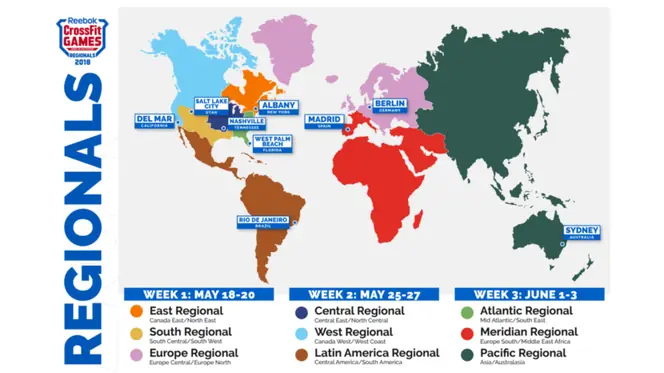
However, this model was not perfectly equal. Some regions had deeper talent pools than others, leading to uneven distribution of Game spots. In 2018, for instance, most Regionals qualified five men, five women, and five teams to the Games. Conversely, the Meridian Regional only qualified four of each, while the Latin America Regional qualified merely one of each. This format always balanced competitive depth, geography, and representation.
Today, this compromise is still pivotal to ongoing discussions.
CrossFit has shifted away from traditional regional terminology. In 2024, some Semifinals retained explicit regional names, like Asia, Europe, Oceania, and others. However, by 2026, the schedule categorizes live qualifiers under a broader term: In-Person Semifinals, identified by event names and locations instead of regions.
Despite these changes, the significance of these locations remains. Competitions in South America, Europe, Asia, or Africa still carry regional weight, especially when Games spots are scarce and athletes from outside those markets compete.
This season has highlighted these tensions.
At Copa Sur, held in São José, Brazil, there were two Games spots for individual men, two for women, and one for a team. The male spots went to Kalyan Souza from Brazil and Benjamin Reyes from Chile. However, both female spots were captured by North American athletes, Anikha Greer and Miley Wade. The team invitation was claimed by CrossFit Hendersonville, based in the United States.
The French Throwdown, taking place in Paris, further highlighted this issue, as American competitor Jayson Hopper won the men’s division.
The intent here is not to doubt these athletes’ performances. They chose events within their reach and competed fairly to earn their spots. In an increasingly professional environment, athletes consider travel costs, competition depth, and other factors to optimise their chances of reaching the Games.
However, a key question remains: do all athletes have the same freedom to make these choices?
For athletes in established CrossFit regions, participating in a different Semifinal can be strategic. While it still requires expenses, support from sponsors or systems may help make such choices feasible. For those from less equipped regions, theoretical options may not translate into practical reality. The costs of travel, lodging, visas, and time off from work can make competing elsewhere impractical.
Copa Sur highlights these disparities, particularly in Latin America, where there have historically been fewer Games opportunities than in stronger markets. Some limited qualifying spots in 2026 went to athletes from outside the region. This broader issue illustrates a qualification model that rewards those who can travel, which is not an equal opportunity for every athlete.
This gap is significant because strategy often involves financial considerations. When a competitor from a strong market enters a qualifying event in a region with fewer slots, the competition may be fair, yet unequal before it even begins.
CrossFit now inhabits this uncomfortable middle ground.
The CrossFit Games aim to crown the Fittest on Earth. This central theme demands that any qualification system ensures fairness. Yet, the Games also showcase CrossFit’s global presence. A world championship needs the best athletes and a route that does not marginalise regions still developing.
Currently, the Semifinals model appears unresolved.
These events are no longer Regionals as they used to be, and CrossFit has shifted away from using regional names for every live qualifier. However, they are not entirely detached from regional significance, as locations, histories, spots, and communities still play a crucial role.
If local access is significant, then rules must be adjusted accordingly. CrossFit has previously implemented region-based eligibility, so this idea isn't new. The question remains whether some version of these protections is still needed in the current Semifinals format or whether that era is completely behind them.
At the same time, the transition towards In-Person Semifinals indicates a shift to a more international format. This evolution illustrates the broader dynamics of a sport where athletes, events, and audiences increasingly cross borders. However, terminology changes alone do not address the core issue of access. As the pathway to competition becomes increasingly global, it is vital to ensure that it does not merely benefit athletes and markets well-positioned for travel.
The focus should not be on whether athletes should pursue the best competitive opportunities available to them; they will because that’s what elite training entails. The critical question is whether CrossFit competitions have outgrown the regional model that its qualification system still partially depends on.
The legacy of Regionals provided a sense of place during the competitive season. Sanctionals created a global event culture, while the current Semifinals model attempts to blend the two. This may exemplify the current state of CrossFit competition: it is neither fully regional nor completely separate from regional implications.