Building Stronger Legs: Effective Exercises Without Heavy Squats

# Building Stronger Legs Without Heavy Squats
Many believe that heavy squats are essential for developing strong legs, but this is not entirely true. While squats can help increase leg muscle size effectively, they are not the only way to achieve muscle growth. Research shows that muscle size, also known as hypertrophy, is influenced by factors such as mechanical tension, the volume of training, proximity to muscle failure, and progressive overload. This means individuals can build impressive leg muscles without consistently using heavy weights.
This information is beneficial for various athletes, including those with joint pain, older individuals, people recovering from injuries, and those who lack access to heavy lifting equipment. It also helps CrossFit athletes who may already stress their bodies through various high-impact activities. Understanding how to stimulate muscle growth can help individuals choose exercises that effectively target leg muscles while lowering the risk of injury and fatigue.
## Why Heavy Squats Aren't Mandatory
The assumption that heavy squats are necessary for leg development stems from their effectiveness. Squats engage multiple muscle groups and allow for long-term progressive overload. However, research indicates that muscle can grow across a wide range of loading intensities. Studies comparing heavy and lighter weights executed close to muscle failure have shown similar growth outcomes when effort levels are matched. The body responds to mechanical tension and muscle fatigue rather than the specific exercise being performed. Therefore, exercises like Bulgarian split squats, leg presses, walking lunges, and more can significantly enhance leg hypertrophy.
Heavy squats do place considerable stress on the spine and joints, which can limit recovery and training frequency. For many lifters, reducing the volume of heavy squats can actually lead to better overall performance, allowing for more effective training throughout the week.
## Key Factors in Leg Muscle Growth
### Mechanical Tension
The force that muscle fibers experience during contraction is known as mechanical tension. It is regarded as the most crucial factor for muscle growth. While heavy lifts generate high tension, lighter weights can also produce significant tension when taken close to failure. As muscle fatigue increases, the body activates larger motor units and additional muscle fibers to maintain strength, explaining why lighter movements, like walking lunges, can build muscle effectively.
### Training Volume
Training volume refers to the total work completed in a workout. Research suggests that higher volumes are linked to greater hypertrophy, within individual recovery limits. Athletes may struggle to accumulate sufficient volume with heavy squats due to the fatigue they cause. Therefore, alternative exercises can allow more productive work without excessive fatigue.
### Proximity to Failure
Muscle growth relies heavily on recruiting high-threshold motor units. Performing sets close to muscle failure maximizes recruitment. While not all sets need to end in total exhaustion, stopping with one to three reps left can be effective. Many machines and unilateral exercises are beneficial because they let lifters push hard with lower injury risks.
### Exercise Choice
Exercises challenge muscles uniquely, and training muscles in stretched positions may enhance growth. Movements like Bulgarian split squats or Romanian deadlifts provide tension while the muscles are elongated.
## Effective Exercises for Bigger Legs
Here are some recommended exercises to build larger leg muscles without heavy squats:
- **Leg Press**: This focuses on the quadriceps and glutes while reducing spine stress.
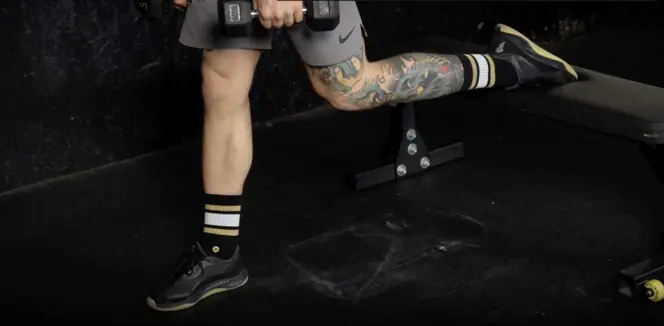
- **Bulgarian Split Squat**: This unilateral exercise targets multiple muscles and is highly effective for muscle growth.
- **Walking Lunges**: Offering both mechanical tension and metabolic stress, these improve balance and coordination.
- **Step Ups**: These target quadriceps and glutes with reduced impact and are effective in athletic performance.
- **Leg Extensions**: These isolate the quadriceps, which can significantly boost training volume without adding fatigue.
- **Romanian Deadlifts**: These are excellent for strengthening hamstrings and glutes, as they induce substantial tension.
- **Hamstring Curls**: Effective for knee flexion, these complement hip hinge movements for well-rounded leg development.
## Advantages of Unilateral Training
Unilateral exercises, while often less favoured, have unique benefits. They boost stability demands, enhance muscle activation, and promote higher training volume with less spinal stress. They can also help identify and correct imbalances, aiding long-term progress. Both unilateral and bilateral exercises can be effective—individual choice will depend on specific needs and goals.
## Importance of Range of Motion
Using a full range of motion is shown to support muscle growth. Studies comparing partial and full range training commonly find that larger movement amplitudes yield better hypertrophy outcomes. Exercises employing full ranges like split squats, leg presses, and lunges generally offer larger time under tension and generate more muscle stress.
## How Much Weight Is Necessary?
One encouraging conclusion in exercise science is that muscle growth can happen across a wide weight range. Studies have indicated similar hypertrophy outcomes from heavy and light training when exercises are performed close to muscle failure. This implies that with moderate weights in movements like Bulgarian split squats, similar gains can be achieved as with heavier squats, given that the effort level is high.
## Sample Leg Workout Without Heavy Squats
A balanced hypertrophy program can include exercises as follows:
**Day One**
- Bulgarian split squats: 3-4 hard sets
- Leg press: 3-4 hard sets
- Leg extensions: 2-3 hard sets
- Standing calf raises: 3 hard sets
**Day Two**
- Romanian deadlifts: 3-4 hard sets
- Hamstring curls: 3-4 hard sets
- Walking lunges: 3 hard sets
- Seated calf raises: 3 hard sets
This workout structure enables significant engagement of all major lower body muscles without the necessity of heavy barbell squats.
## Common Missteps When Avoiding Heavy Squats
### Not Training Hard Enough
Some may switch to easier exercises and fail to push them to the point of challenge. Light weights alone are not sufficient for muscle growth.
### Insufficient Training Volume
With alternatives feeling less taxing, many underestimate the necessary workload. Most muscle groups thrive on multiple challenging sets per week.
### Overlooking the Posterior Chain
Many squat alternatives focus mainly on the quadriceps. Ignoring movements like Romanian deadlifts and hamstring curls can lead to weaknesses and limit leg development.
### Reducing Range of Motion
Performing shorter repetitions can lessen muscle stimulation. Aiming for a controlled, full range of motion is crucial.
## Final Thoughts
Building larger legs without heavy squats is entirely feasible and supported by modern exercise science. Muscle hypertrophy depends on mechanical tension, adequate volume, and consistent effort. While heavy squats can be part of the equation, they are not the only effective route.
Movements like Bulgarian split squats, leg presses, and walking lunges can produce substantial growth while minimizing joint stress. By focusing on training hard, ensuring a full range of motion, and balancing volume with proper recovery, remarkable leg development can be achieved—without needing to push for the heaviest squat weights.
### Key Takeaways
- Hypertrophy occurs with various loading weights.
- Muscle growth is driven by mechanical tension and volume.
- Exercises like Bulgarian split squats and leg presses are excellent for growth.
- Consistent effort, proper range of motion, and adequate recovery are vital.
### References
- Brad Schoenfeld, B. (2010) ‘The mechanisms of muscle hypertrophy and their application to resistance training’, Journal of Strength and Conditioning Research, 24(10), pp. 2857 to 2872.
- Schoenfeld, B.J., Ogborn, D. and Krieger, J.W. (2017) ‘Dose response relationship between weekly resistance training volume and increases in muscle mass’, Journal of Sports Sciences, 35(11), pp. 1073 to 1082.
- Schoenfeld, B.J., Grgic, J., Ogborn, D. and Krieger, J.W. (2017) ‘Strength and hypertrophy adaptations between low load and high load resistance training’, Journal of Strength and Conditioning Research, 31(12), pp. 3508 to 3523.
- Morton, R.W., Oikawa, S.Y., Wavell, C.G., Mazara, N., McGlory, C., Quadrilatero, J., Baechler, B.L., Baker, S.K. and Phillips, S.M. (2016) ‘Neither load nor systemic hormones determine resistance training mediated hypertrophy or strength gains in resistance trained young men’, Journal of Applied Physiology, 121(1), pp. 129 to 138.
- Grgic, J., Schoenfeld, B.J., Orazem, J. and Sabol, F. (2018) ‘Effects of resistance training performed to repetition failure or non-failure on muscular strength and hypertrophy’, Journal of Sport and Health Science, 10(2), pp. 202 to 211.
- Bloomquist, K., Langberg, H., Karlsen, S., Madsgaard, S., Boesen, M. and Raastad, T. (2013) ‘Effect of range of motion in heavy load squatting on muscle and tendon adaptations’, European Journal of Applied Physiology, 113(8), pp. 2133 to 2142.
- Pedrosa, G.F., Lima, F.V., Schoenfeld, B.J., Steele, J. and Gentil, P. (2022) ‘The effects of training with full versus partial range of motion on muscle hypertrophy’, Sports Medicine, 52(6), pp. 1307 to 1321.